VIBEPAPA RESEARCH
Same JLPT, Different Minds: Native Language, Kanji, Time Pressure, and Test Performance
Vibepapa Research reviews official JLPT structure, Japanese-L2 experiments, and meta-analyses to explain how transfer, kanji, working memory, and anxiety shape timed performance.
The short answer
A JLPT score reflects more than stored Japanese knowledge: it reflects how that knowledge is accessed through a learner's first-language history, cognitive limits, and a strict clock. A Chinese-character background can speed visual lexical access while creating semantic and phonological interference. Korean-Japanese structural similarity can facilitate specific grammar mappings but is not a universal grammar advantage. Reading also draws on decoding, working memory, metacognition, and anxiety. These mechanisms explain different processing routes, not fixed rankings of language groups.Key takeaways
- Language distance is multidimensional: orthographic proximity does not imply syntactic, semantic, or phonological proximity.
- Among 7,074 Chinese-Japanese isographic words, 18% differ partly or completely in meaning.
- L2 reading is associated with grammar, vocabulary, decoding, and working memory, so identical errors can reflect different bottlenecks.
- In timed L2 reading, working memory was associated with higher odds of accuracy, while reading and response anxiety were associated with lower odds.
- Most reported effects are not JLPT-specific and should be treated as mechanistic evidence, not group rankings.
Research question and evidence boundaries
A test converts linguistic knowledge into a score, but that conversion is not transparent. Examinees must recognize script, activate meanings, parse syntax, maintain discourse information, suppress misleading associations, and decide when to move on under time pressure. The question is not which first language is best for the JLPT, but how different linguistic and cognitive conditions alter processing cost on the same tasks.
The evidence is separated into three layers. Official JLPT material establishes test structure and task demands. Japanese-L2 experiments support specific Japanese-processing mechanisms. Broader L2 meta-analyses and timed-reading studies explain plausible mechanisms, but their correlations and odds ratios are not estimates of JLPT score effects.
The JLPT is also a timed cognitive task
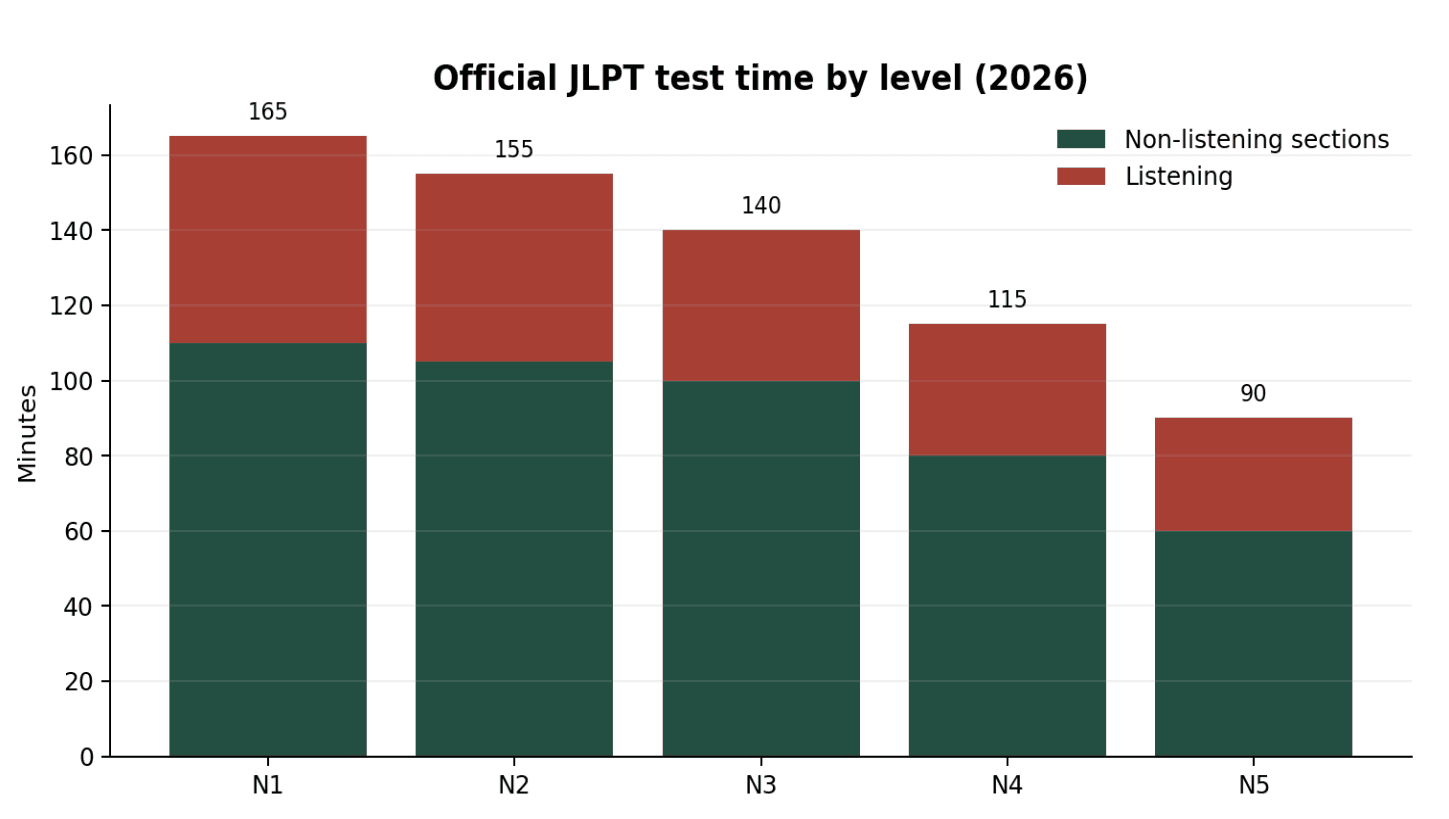
In 2026, N1 allocates 110 minutes to the combined Language Knowledge and Reading section and 55 minutes to Listening; N2 allocates 105 and 50 minutes. N3-N5 split the non-listening components further, but every level has a strict limit. For N1 and N2, the official structure does not prescribe separate vocabulary, grammar, and reading clocks inside the shared section, leaving micro-allocation to the examinee.
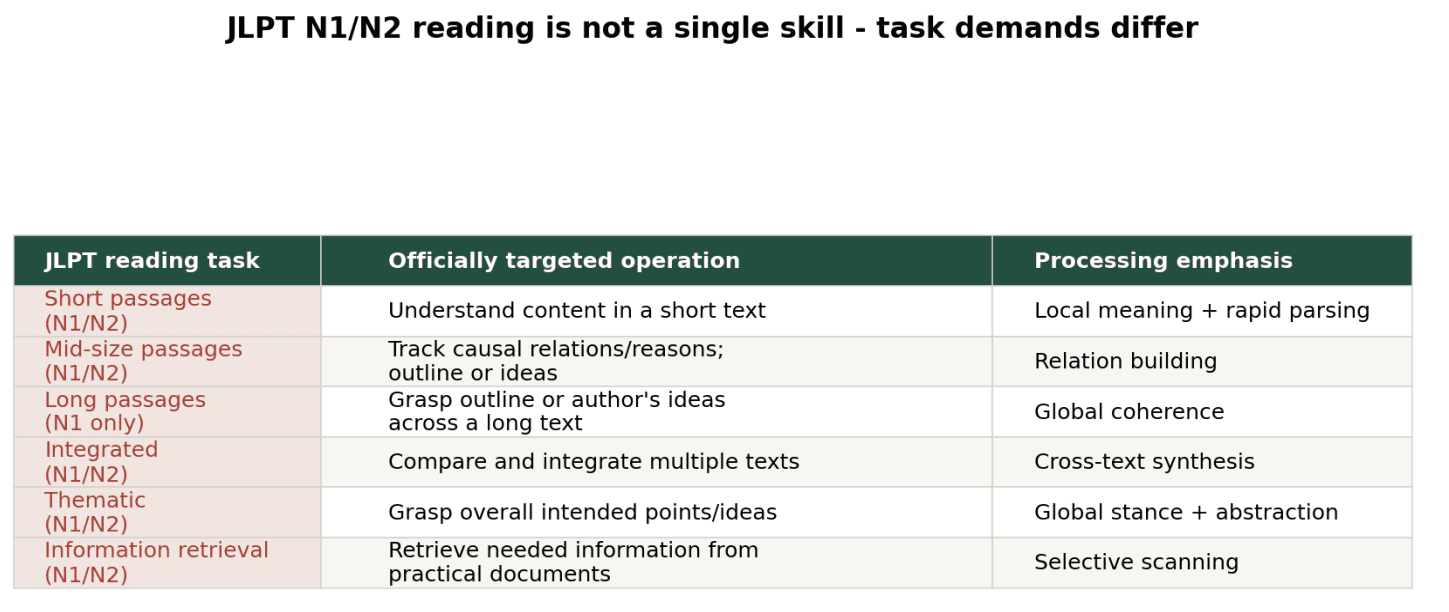
Reading is not one operation. Official item purposes require local comprehension, causal and outline tracking, integration across texts, grasping overall intent, and information retrieval. Text length is only one property and cannot stand in for cognitive difficulty.
First language is not one advantage, but multiple transfer channels
A first language can influence Japanese through vocabulary, orthography, syntax, semantics, and phonology. A learner can be close to Japanese in script while distant in grammar or sound, so reducing language distance to one number hides the mechanism that matters.
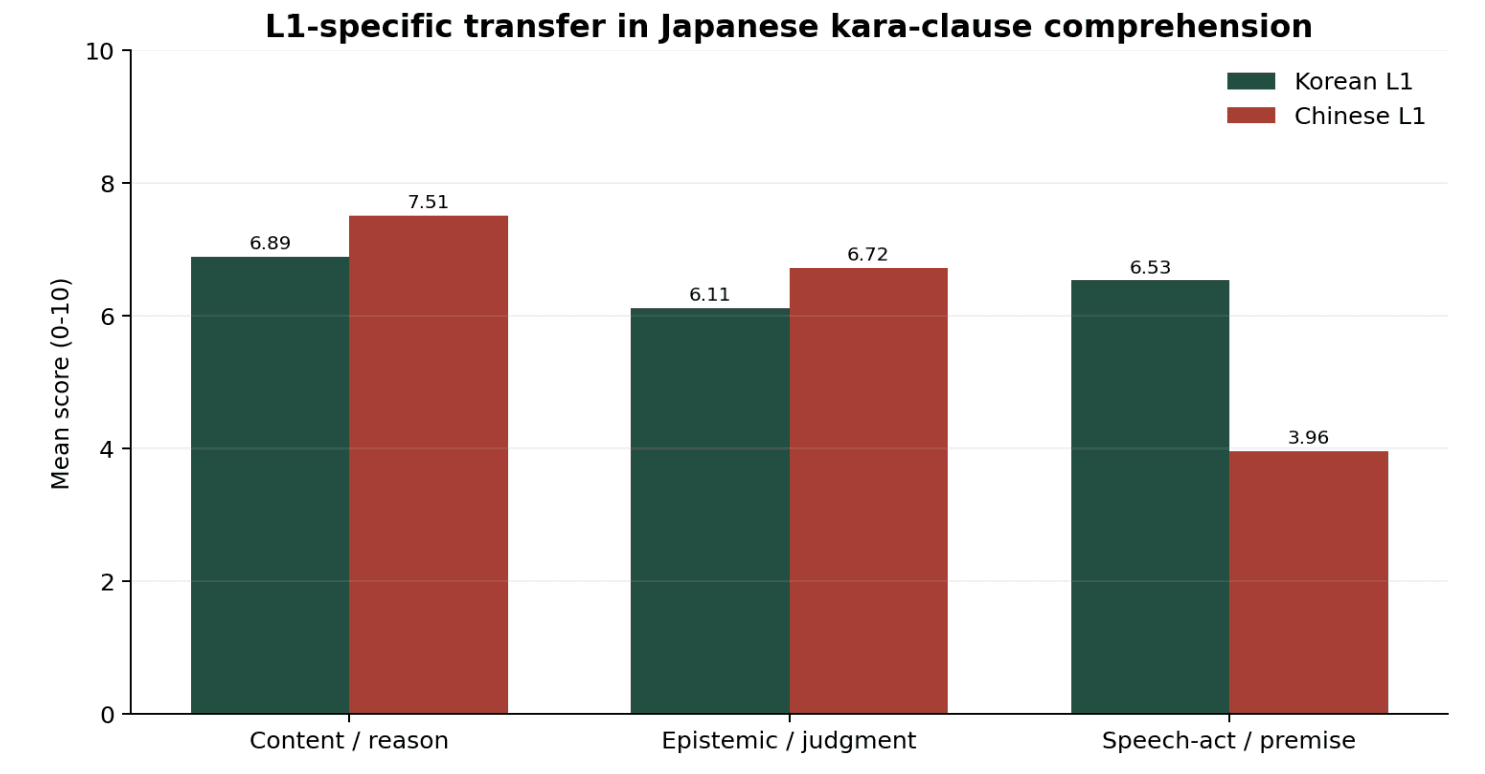
Saito and Tamaoka matched 48 Korean-L1 and 48 Chinese-L1 learners on overall Japanese grammar and tested content, epistemic, and speech-act uses of kara. The groups were similar in the first two domains but diverged on speech-act or premise uses: 6.53/10 for Korean-L1 and 3.96/10 for Chinese-L1. The L1 by domain interaction had partial η²=.16, and the premise-domain group effect had partial η²=.32.
This supports construction-specific transfer, not the claim that Korean speakers are generally better at JLPT grammar. An available L1 mapping may reduce processing cost; a missing mapping can remain selectively vulnerable even at comparable overall proficiency.
Kanji is both a cognitive shortcut and a cognitive trap
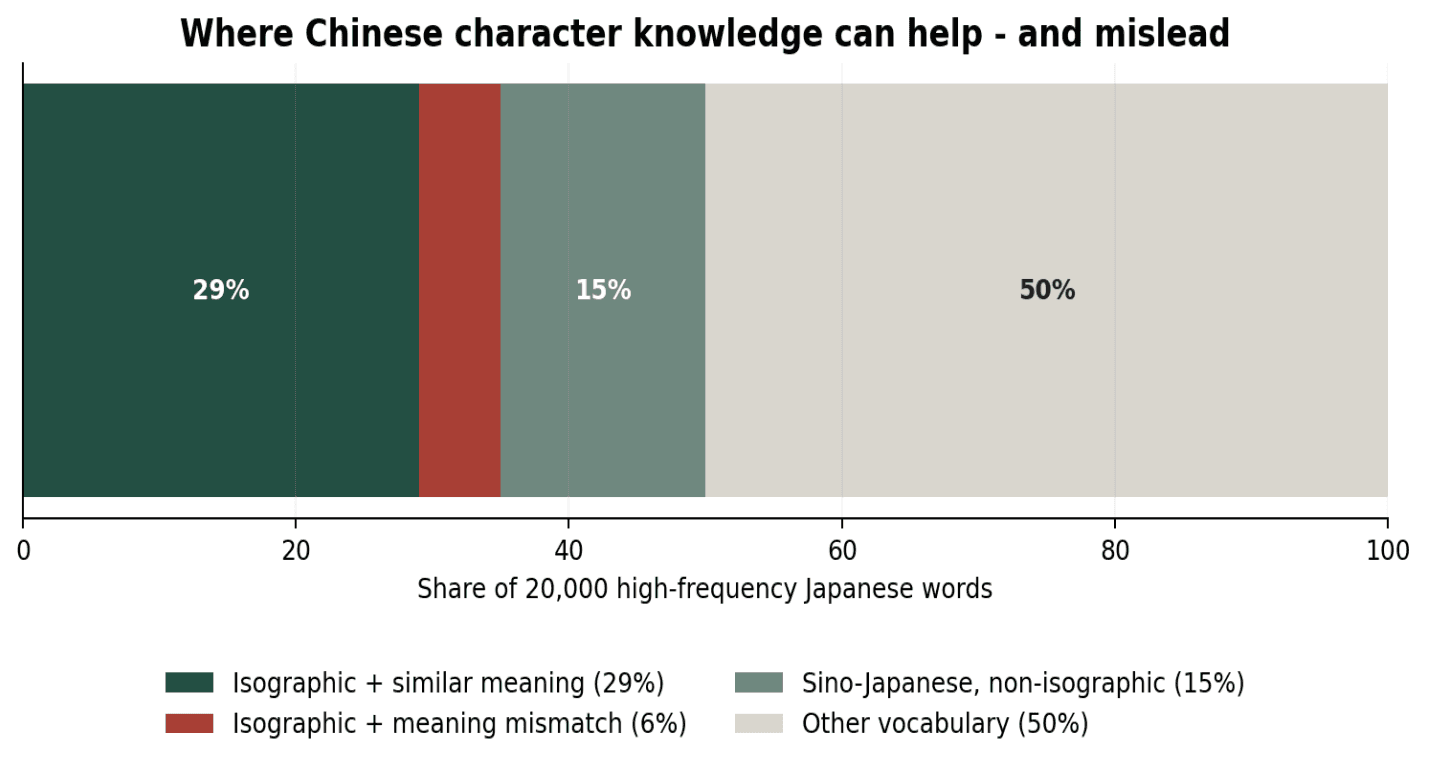
In a database of 20,000 high-frequency Japanese words, Chinese-origin vocabulary accounts for about half. Roughly 70% of those words are isographic with modern Chinese, or about 35% of the whole list. Among 7,074 isographic words, 82% are similar in form and meaning while 18% differ partly or completely in meaning. Roughly one in every five to six apparently familiar isographs therefore carries meaningful semantic risk.
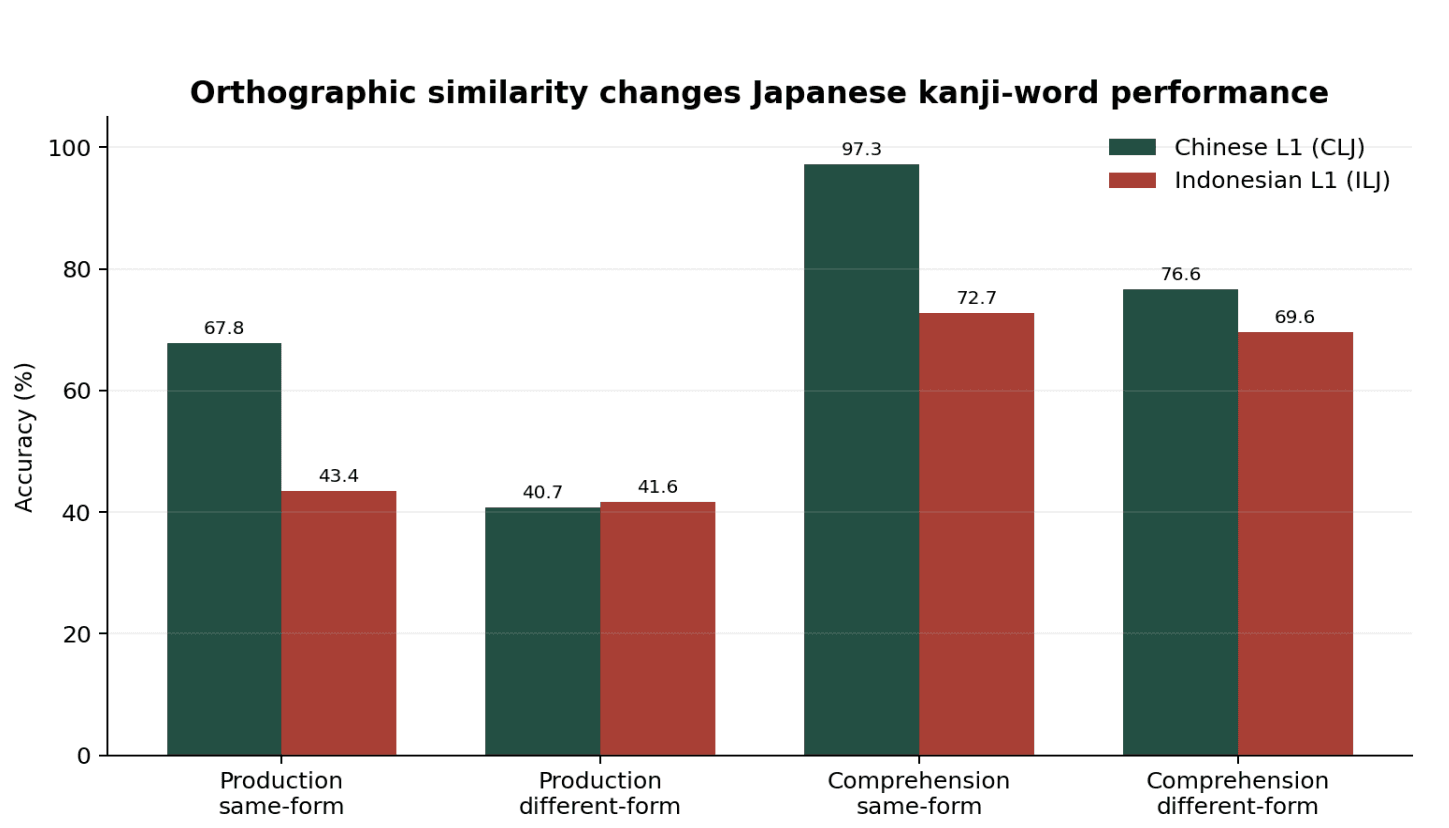
Meng compared intermediate Chinese-L1 learners (n=46) with proficiency-matched Indonesian-L1 learners (n=29). Same-meaning, same-form comprehension accuracy was 97.27% versus 72.73%, and production accuracy was 67.76% versus 43.40%. On same-meaning, different-form production, the groups were nearly identical. The within-Chinese-L1 effect of form similarity on comprehension was η²=.62.
Script familiarity can make recognition and meaning access highly efficient without automatically transferring to productive Japanese control. A Chinese character association can also cue an answer that looks plausible but is wrong in the current Japanese context.
Visual kanji advantage does not automatically become listening advantage
Auditory lexical-decision research with Chinese learners of Japanese suggests that cross-language orthographic similarity can facilitate recognition even when words are heard, while phonological similarity can inhibit performance under some conditions. Homograph and homophone studies also show competing Chinese conceptual and sound representations.
Visual lexical facilitation should therefore not be projected onto every JLPT modality. Listening requires segmentation, lexical selection, and contextual integration along a sound timeline; visual familiarity does not transfer in the same proportion.
Reading is a multi-component cognitive bottleneck
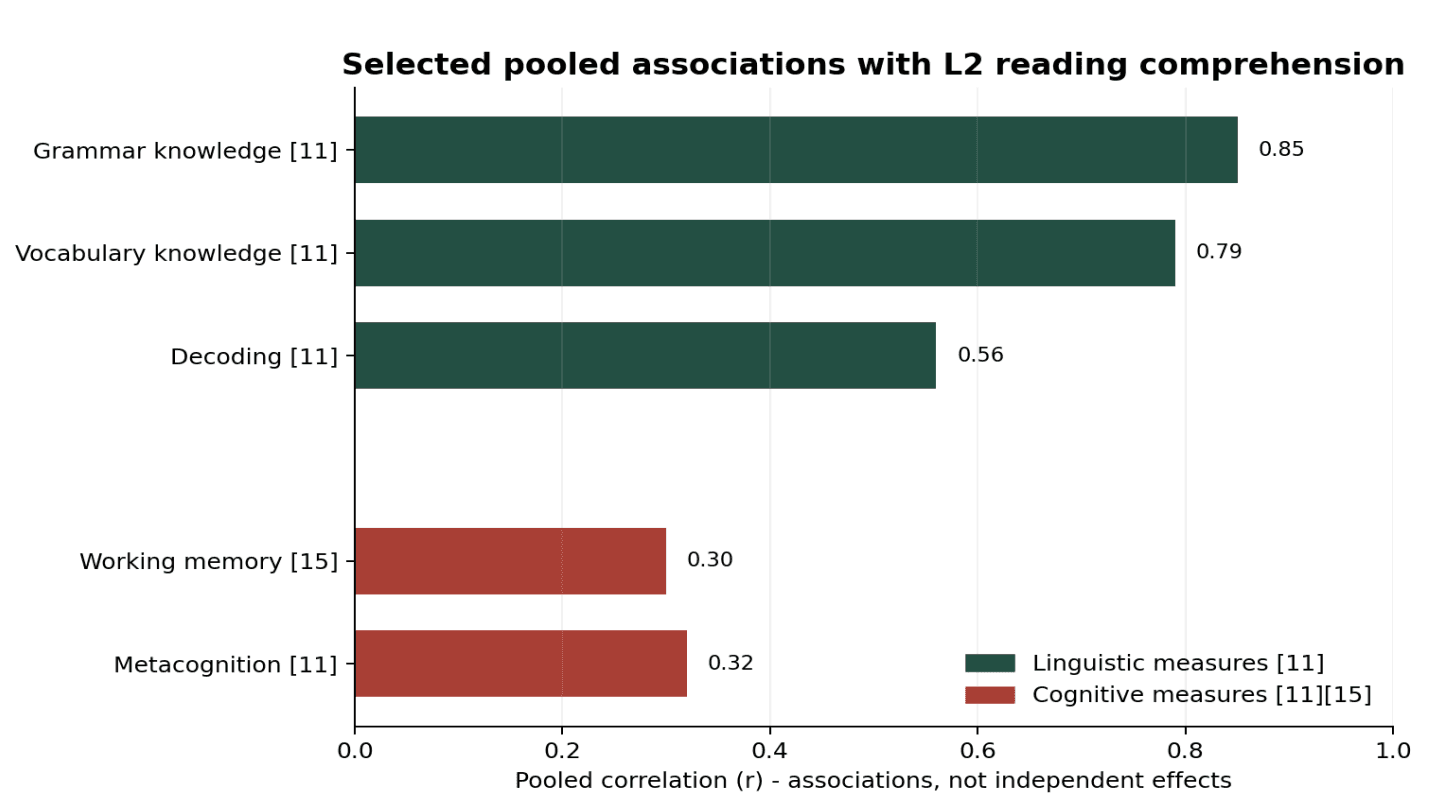
Pooled associations with passage-level L2 reading were r=.85 for grammar knowledge, r=.79 for vocabulary, r=.56 for decoding, and r=.32 for metacognition. A separate meta-analysis of 74 studies and 228 correlations estimated the working-memory relationship at r=.30. These bivariate associations cannot be added as explained variance or interpreted as independent causal contributions.
In a JLPT context, one wrong answer may reflect unknown vocabulary, misparsed grammar, failure to maintain a referent, an incorrect inference, loss of the author's global stance, or simply running out of time. A reading score compresses different processes into one outcome.
Time pressure, working memory, and anxiety
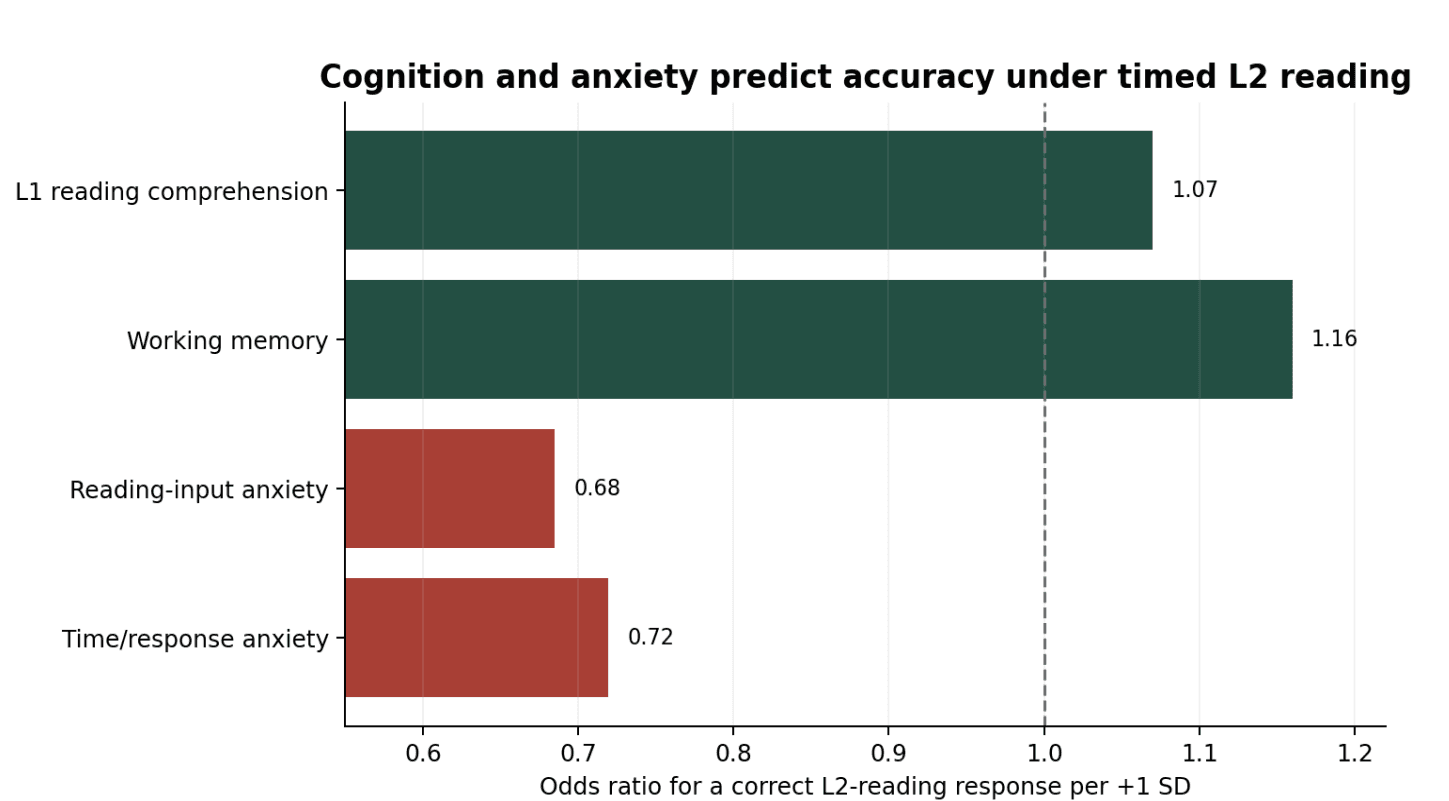
A timed L2-English reading study of 96 Hungarian secondary-school students measured L1 reading, working memory, reading anxiety, time or response anxiety, accuracy, and completion time. It is not a JLPT study, but it provides a useful model of cognition under a clock.
A one-standard-deviation increase in working memory was associated with odds of 1.16 for a correct response, and L1 reading with odds of 1.07. Reading-input anxiety corresponded to OR≈0.68 and time or response anxiety to OR≈0.72. Higher reading-related anxiety also appeared with slower completion, although a causal feedback loop has not been established in JLPT examinees.
A broader 2019 meta-analysis of 55 independent samples and 10,228 participants found r=-.34 between foreign-language anxiety and performance; listening anxiety and listening performance had r=-.53. The evidence establishes association and is compatible with resource competition, not a single causal direction.
| Finding | Value | Evidence scope |
|---|---|---|
| Korean vs Chinese kara premise | 6.53 vs 3.96 /10 | Japanese-L2 experiment, N=96 |
| Meaning mismatch among isographs | 18% of 7,074 | Lexical database |
| Same-form comprehension | 97.27% vs 72.73% | Chinese L1 vs Indonesian L1 |
| Reading with grammar / vocabulary | r=.85 / r=.79 | L2 meta-analysis |
| Reading with working memory | r=.30 | 74 studies, 228 correlations |
| Foreign-language anxiety and performance | r=-.34 | 55 samples, 10,228 participants |
| Time anxiety and correctness | OR≈0.72 per +1 SD | Timed L2 reading, N=96 |
A layered psychological model of JLPT performance
A better model is layered rather than language ability versus psychology. L1 transfer changes the cost of particular mappings; orthographic and phonological transfer shape lexical activation; reading architecture aggregates multiple skills; working memory limits maintenance; metacognition guides allocation; and anxiety can vary with both accuracy and speed.
The defensible formulation is that JLPT performance is proficiency expressed through a particular cognitive pathway under time constraints. This does not mean the test mainly measures psychology, but equal stored knowledge does not guarantee equal scores when processing speed, transfer, and allocation differ.
| Layer | Mechanism | Possible expression |
|---|---|---|
| L1 transfer | Available or absent grammar-semantic mappings | Specific meanings processed faster or slower |
| Orthographic transfer | Kanji form and meaning co-activation | Efficient access or false familiarity |
| Phonological transfer | Interaction of L1 and Japanese sound representations | Listening need not mirror visual advantage |
| Reading architecture | Vocabulary, grammar, decoding, inference | Different bottlenecks yield the same error |
| Working memory | Maintain and integrate information | Limits across sentences and passages |
| Metacognition | Monitor difficulty and decide when to move | Allocation differences in shared sections |
| Anxiety | Worry and time threat consume resources | Lower accuracy or slower completion |
Implications for preparation, mock tests, and research
Preparation should diagnose the bottleneck rather than only add hours. Chinese-background learners can train false friends, kana and phonology, and context-sensitive meanings; non-kanji-background learners may need stronger orthographic automaticity. Korean-background learners can use some structural similarities, but one construction cannot be generalized to all grammar. Timed reading should separate knowledge failures from allocation failures for every learner.
With informed consent and anonymization, mock tests could record L1, item response time, revisits, answer changes, item position, and section accuracy. That would allow tests of whether kanji backgrounds reduce orthographic response time, particular L1s change error types, and late-section accuracy declines after controlling for item difficulty.
The largest gap is official-JLPT item-level response time linked to L1 background. Preregistered, multilingual JLPT-like experiments with matched proficiency and item difficulty would be more informative than nationality rankings.
Limitations and conclusion
This is a structured narrative review, not a meta-analysis of JLPT examinees. Japanese-L2 experiments often use modest samples and specific constructions or word types; the larger reading and anxiety evidence comes from broader L2 settings and may not generalize in magnitude to Japanese testing. Correlation cannot establish direction of causality.
Chinese-L1, Korean-L1, and other labels are not psychological types. Education, dialect, bilingual experience, literacy history, and proficiency vary within every group.
The same JLPT can impose different processing costs. The fairest interpretation is not that scores are contaminated by psychology, but that proficiency is always observed through a cognitive system with a language history, limited resources, and a clock.
SOURCES
References
- Japan Foundation & JEES: Composition of Test Sections and Items (2026)
- Japan Foundation & JEES: N1 Purposes of Test Items
- Japan Foundation & JEES: N2 Purposes of Test Items
- Saito & Tamaoka (2021): Comprehension of the Japanese Non-reason -kara Clause
- Yamagata (2008): L1 background and lexical inferencing in Japanese text comprehension
- Matsushita et al. (2020): Chinese-Japanese kanji vocabulary database
- Meng (2021): Japanese single-kanji verbs among Chinese- and Indonesian-L1 learners
- Fei & Matsumi (2012): Auditory recognition of Japanese kanji words
- Tome (2015): Auditory recognition of Chinese-Japanese homographs
- Ma & Morita (2020): Homophone judgments of kanji words
- Jeon & Yamashita (2014): L2 reading comprehension and its correlates
- Jeon & Yamashita (2022): Updated meta-analysis of L2 reading correlates
- Kormos (2026): L1 skills, working memory, anxiety and timed L2 reading
- Zhang (2019): Foreign language anxiety and performance meta-analysis
- In'nami, Hijikata & Koizumi (2022): Working memory capacity and L2 reading
FAQ
Frequently asked questions
Do Chinese speakers have a natural JLPT advantage?
Chinese character knowledge often supports visual lexical access, but false friends, phonological control, and auditory processing can also create interference. The advantage is task- and word-specific, not a general advantage across every JLPT section.
Does test anxiety directly cause lower JLPT scores?
Broader L2 research links anxiety with lower performance and slower completion, but the public evidence does not establish a one-way causal effect on JLPT scores. Proficiency, item difficulty, and previous performance can also shape anxiety.
How can I distinguish a reading-knowledge problem from a timing problem?
Compare the same task type under untimed and timed conditions while recording response time, revisits, and changes. Untimed success with timed failure points toward speed, attention, or allocation; failure in both conditions points first to vocabulary, grammar, or inference.
NEXT STEP
Turn the decision into a realistic practice run
Use the free level check to find your range, then validate pace, listening, and consistency with a full mock exam.
PDF · 10 pages · research paper
Download the complete research paper
The PDF includes the complete charts, data tables, methodology, and references.
© 2026 Vibepapa Research. All rights reserved. Reproduction, republication, or commercial use requires permission.